by Renee Lindstrom, founder, Inside Awareness Center for Integrative Somatic Learning
Listen to audio in author’s voice
A newborn arrives with the qualities of self actualization and then transitions into the survival emotions to meet basic needs for safety and spending the rest of their life trying to climb back up the hierarchy to regain it, along with their self esteem.
Background Preamble to satisfy source of this blog articles content
This author became focused on Maslow’s Hierarchy of Needs during her teaching and study of Nonviolent Communication. Nonviolent Communication offered guided cognitive patterns for turning disconnection into connection through dialogues and listening skill development. Through the honesty and commitment for mutual give and take, the practical applications of these guided patterns can be an opportunity to integrate a deeper somatic mindfulness where the true connection lies. As a practitioner of the guided patterns, this author became aware that there was also the possibility to cognitively use the patterns as strategies to deepen power over others. Over time there was recognition in the two individual focuses of attention one had when using these guided patterns. One focus was through the somatic experience of the five senses and the other were the cognitive interpretations of feeling words.
At the beginning of this author’s NVC journey there were no learning components that included the Hierarchy of Needs model yet that is not to say people hadn’t been using it in their own local areas. It is only acknowledgement that it wasn’t used in any of the trainings this author participated in. The use of the model came through the ongoing teaching of the model and personal shift into a full on focus of the value needs. In the years between ’07 and ’09 this author became aware that students had no inner connection to understanding individual values. Values were completely missing in their individual definitions. This meant that there was no integrative experience that would create a deeper connection to understanding their significance as root causes to reactional behaviour. In this context behaviour can include emotional, mental or physical reactions. .
This discovery came after this author graduated from an intense four year somatic education in the Feldenkrais Method where the primary vehicle for learning was a focus on integration and mindful focus of attention in present moment experience. It was also after seven years in a personal NVC practice and as a teacher in the community.
The seeds of learning through exploring the somatic senses began through the study of Buddhist meditation for this author, where the primary focus in sitting was on being present somatically in the environment. It was training to look inward to explore the connection between stimulation and response as it was taking place.
The integration of NVC and Feldenkrais became an extended complimentary education of Buddhist Meditations mindfulness that satisfied this author’s western socially conditioned mind.
The inversion of the experiential categories described in Maslow’s Hierarchy of Needs begins in the newborn early development as a result of the learning environment they find themselves in. This author suggests that a newborn enters into the living environment after birth with enhanced somatic awareness. It is through the interaction in the living environment that they become exposed to cognitive conceptualized intellectualization. Two pyramids reflecting Maslow’s Hierarchy of Needs are as follows:
Cognitive Conceptualization of Needs using Maslow’s Hierarchy
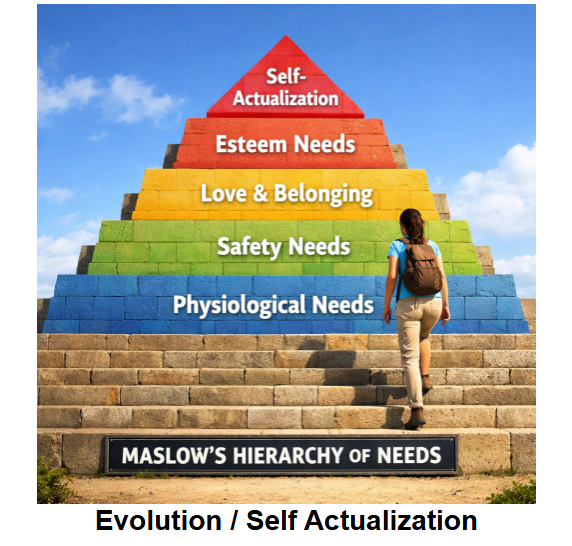
This diagram demonstrates the cognitive understanding of achievement. It begins with getting the basic needs met before moving up to elevated experiences.
Somatic Experience of a new born using the concepts as defined in Maslow’s description of Needs Hierarchy
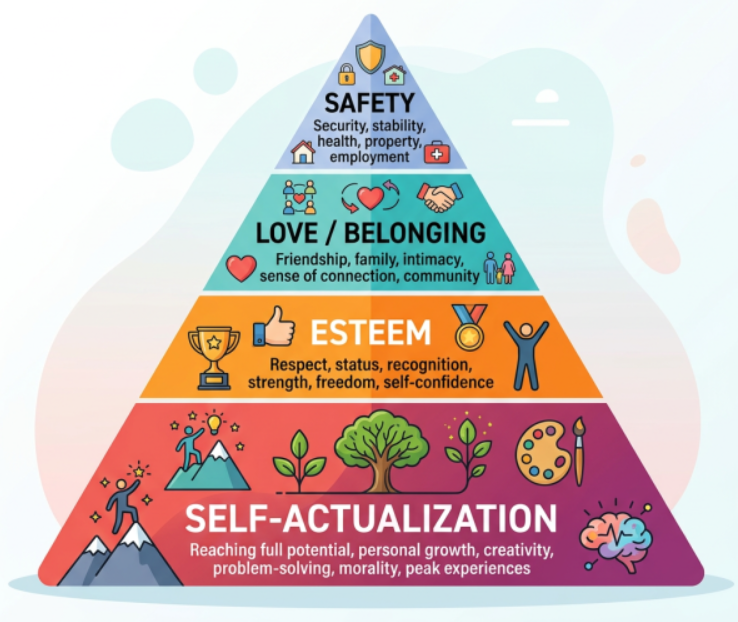
In the interpretation of this second diagram this author has shifted self-actualization to the bottom with self esteem above followed by love and then safety, She is suggesting that when a newborn experiences utero in a healthy pregnancy, physically, mentally and emotionally, they emerge with a higher state of somatic consciousness. Anyone in a healthy environment with a healthy newborn can probably agree they witness qualities of high self-esteem in the aging process. As a practitioner this author experiences the transition between these two interpretations as unconscious in the social conditioned process that influences mental, emotional and physical states of being through the aging process. This social conditioning includes a comprehensive understanding that it’s just a part of the normal process to loose functional abilities through living and aging. As a practitioner of behaviour through somatic function it is an interesting exploration.
This inquiry has been the question, when did the child lose their foundational abilities for meeting life in the somatic experience of self-actualization and expression of self-esteem in response to becoming compromised? Such as;
When did the inversion happen?
What was the inversion in response to?
In one on one functional integration sessions these questions are personal considerations, yet not specifically asked. Only an open understanding and potential to blocks in patterns that are not available through expression, physically, mentally and emotionally.
Educationally it is a consideration of the socially conditioned patterning in society and educational institutions.
Currently, in conversation this author hears the cognitive evaluations that tend to go into stories of right and wrong, and blame and shame, that denies any responsibility in the present moment as an adult. The focus is on the child experience of the past, through the lens of a child and not as a responsible mature adult in the moment. What is missing is the understanding of self-empathy and empathy for others even if not in agreement. In this context the focus is on the core connection to value needs in reference to empathy in the same view as a meditator would view the inner causation that initiates response. What is missing is the story of attaching judgment, blame and shame in this mindful process.
This process is described for focus on value needs that are at the core of observation, to sense the initial stimulus within that can replace the justification for being right in the past story. It is this author’s experience that when reaching this shift, a person regains their self esteem that shifts their self value and it is the point of regaining the ability for self-actualization. It’s the simplest differentiation, yet the hardest to achieve. Many will not achieve it in their lifetime. This experience has been through the inner process of information incoming and spoken word, physical functional responses and felt sense responses for this author and in students she has mentored. The challenge is in the resistance itself. Those who trust and release resistance integrate learning quicker than those embedded in the past who are challenged by change. There is no right or wrong, it is in the safety that is identified in the two diagrams. A baby loses their abilities due to a lack of safety in their experiences in their environment mentally, emotionally and physically. The adults are stuck in that dense reaction to life until they stop resisting change and are willing to walk up towards the self-actualization skills they were born with. It may not happen in this lifetime. At some point after birth the child lost their free will to make choices due to the social conditioning which usually involves trauma when safety needs were not met, and where there was a lack of education on value needs. The child never learned to identify the value needs in a way to articulate them, therefore leaving them unable to meet them on their own. They have no idea what they are through connection to an inside felt sense of them. Values have not been integrated mentally, emotional or physically. It’s missing in our education in a meaningful way, or has been in the past.
If you’ve read or listened this far, I appreciate your time and consideration of this valuable learning point. It is a key aspect for improving one’s life physically, mentally and emotionally. It can be learned as it is simply a gap in the development process. This author has learned it is never too late and that it is possibly the most rewarding and abundant experience. This process of relearning to self actualize reintegrates self esteem that initiates the felt senses of joy, pleasure, peace and balance. Qualities needed to make wiser choices self confidently. This includes physical postures that express through flexibility and limberness.
If you would like to connect to learn more about educational opportunities, coaching, mentoring , consulting or functional integrations
PODCAST
Please like and subscribe if you like this content.
Follow Socials:
Facebook, LinkedIn, Instagram, TikTok, X or Pinterest, Tumblr
Feldenkrais®, Feldenkrais Method®, Awareness Through Movement®, and Functional Integration®, are registered service marks of the Feldenkrais Guild® of North America. Feldenkrais Method®
Copyrighted Property posted on Renee’s authentic accounts only:


Leave a Reply