by Renee Lindstrom, Author of the Teaching Labyrinth, by a real person
In the late 90’s I was introduced to the Mindfulness of the Labyrinth Pattern in a conference for Scientists and Mystics held in 100 Mile House. The Scientists were retired and as they worked out in the field, they didn’t work in labs or with advanced technology. We were a group of dowsers, therefore the topics were not the usual scientific format. It was from their personal interests.
It was at this event that I was introduced to a Labyrinth. It was a guest that created a Labyrinth for everyone to enjoy during the weekend. It was a weekend of firsts. Scientists speaking to energies and moving matter, labyrinth and fire walks, and trust falling. Less than 10 years later a Labyrinth was created for our graduation walk to receive our Feldenkrais certification after four years of study. It was a beautiful shared community event. A decade later I was involved in the Greater Victoria Labyrinth Community to cultivate awareness of their local existence and educate others on their benefits.
I am slowly concluding that the Labyrinth was designed after the pattern of the human body. I know that all early shapes and lines originate from nature, and were created from environmental influences and copied. This conclusion has been developing for years. I had the opportunity to experience a faith-based interpretation of the Labyrinth given to a group of mixed junior and senior high students which I followed with a somatic movement and dialogue presentation for developing leadership. One focus was outside and focused on that strategy of a higher authority while the other was focused on inside doable and practical actions that could be integrated into all daily activities. It was an interesting and educational experience deepening this conclusion.
The Body Reflection of the Labyrinth
The Labyrinth from my perspective as a trained Practitioner of the Feldenkrais Method of Somatic Education has a focus on the functional patterns of the human body. The other perspectives surrounding the labyrinth are faith-based, artistic and creativity, mathematical alignment with the universe and culture. An introduction to the Labyrinth through a dowsers influence ignited an attitude of curious investigation versus developing a strong belief system. This meant that the focus on functional movement, somatic dialogue and environmental influences was the lens that I view and experience the labyrinth patterns. I can’t miss the repeating patterns between the two, Feldenkrais and Labyrinth patterns.
The synchronicity in the Labyrinth and Feldenkrais Patterns
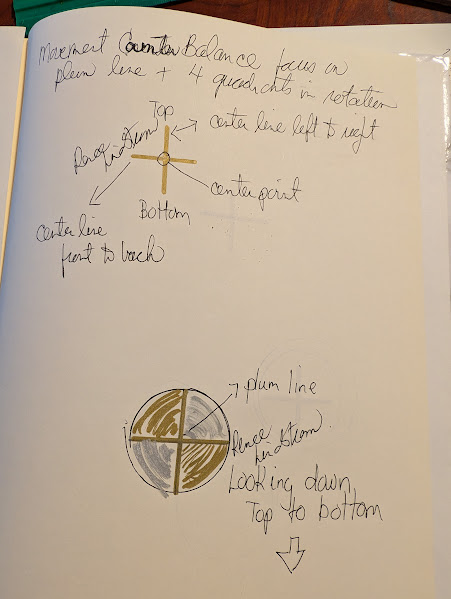
The pattern I refer to here is the core pattern that is called the seed pattern in the Labyrinth. It is the center cross that creates the four cardinal directions in the rotational walking pattern through the Labyrinth inward and outward. In the Feldenkrais Method the core pattern in the body is the elusive plum line that creates the four quadrants. Both the Labyrinth and Feldenkrais mirror the cardinal directions of the compass. In Feldenkrais, it can be felt in the subtle shift in body weight through the rotational patterns in postural transitions.
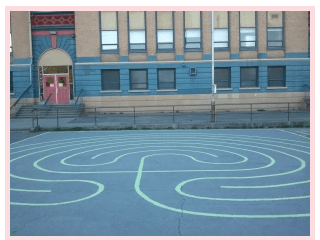
When I draw a Labyrinth I can see a reflection of a human body. Here is a picture of a Labyrinth that was on a children’s playground at one of Greater Victoria’s Elementary Schools, George Jay. I used this picture as it is at an angle which clearly shows the lines of the body in an abstract way. The cross is evident and it creates a mirror image of the two sides. For me, I view two arms, two legs and rounded lines at the top of the straight line that reflects the curvature of the head. All the pathways leading off these core lines are rounded. I see these as ribs. The straight line is the spine and the curved lines are the ribs. The spine, ribs, arms and legs reflect rotational movement in the Feldenkrais Method.
If I look at a Traditional Labyrinth pattern, the circle in the center mirrors the rib cage. The cross at the entrance and up is the spine. The ribs are rounded and rotate as the vertebrae of the spine rotate. The spine is encouraged to rotate due to the shifting weight in the arms, shoulders, pelvis, legs, and feet.

When travelling to schools to share the labyrinth pattern, I approached it from the perspective of the plum line, shifting body weight and integrating this connection to the movement for clarity. The second focus point was a novel connection to the mindfulness walk into the core of the Labyrinth and back out. Movement can support the transition of emotions from heightened states into calm, and peacefulness. The walk into the Labyrinth can reduce reactive states and encourage better decisions.
It was these educational presentations that led to the Teaching Labyrinth and the Culture of Values Program.

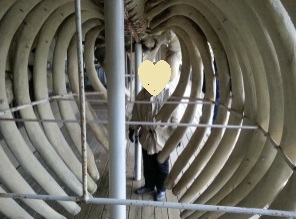
Click Picture of Whales Ribs to read more on the view from inside them
Read more on Awareness through Feldenkrais
Please like and subscribe
Follow on Facebook, LinkedIn, Instagram, TikTok, X or Pinterest
 Renee Lindstrom, GCFP
Leave a comment